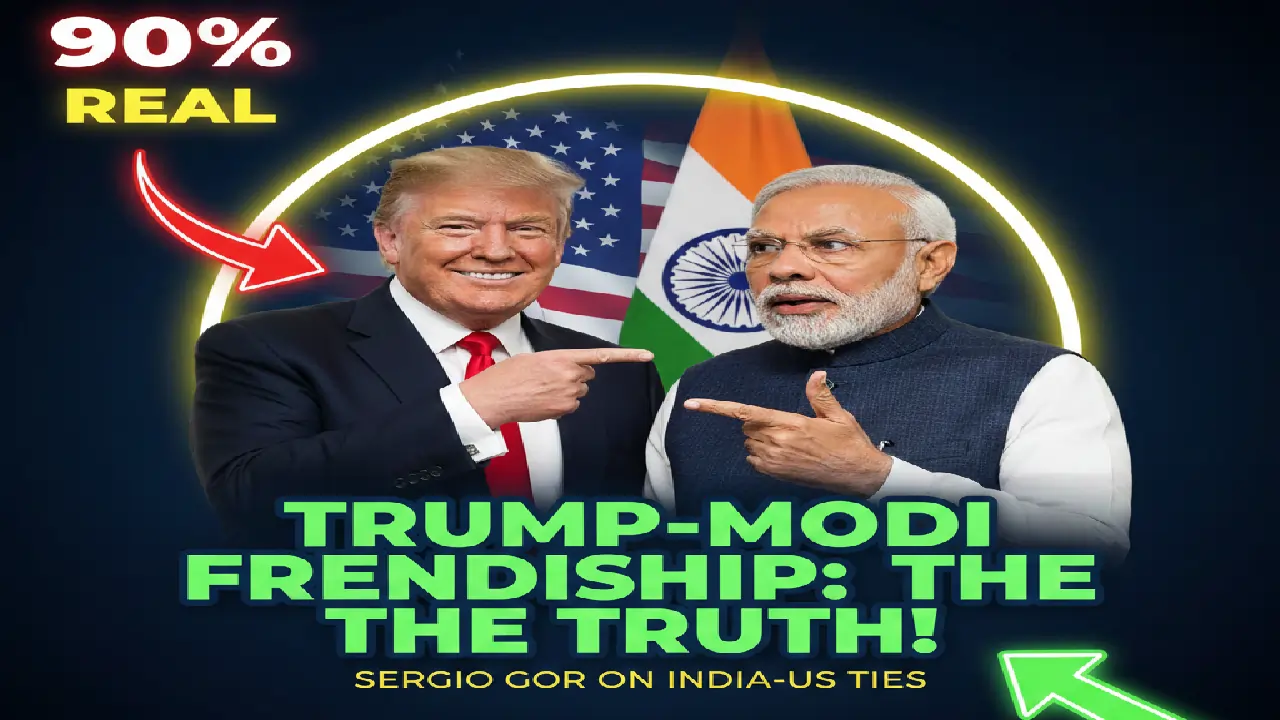

Donald Trump and Prime Minister Narendra Modi
The friendship between President Donald Trump and Prime Minister Narendra Modi is genuine. This is not a point of discussion; it is my personal experience, having been on the road with President Trump around the globe. It was my mission to use that sincere personal connection to propel the most significant alliance in this century as the new United States Ambassador to India, and I had landed in New Delhi.
True friends can fight, and they manage to settle their differences eventually. It is not merely a diplomatic platitude, but it is the basis on which we are cultivating to sail us through some complicated trade talks, strategic alliances, and common democratic values that have cemented the world’s oldest and largest democracies.
The official invitation at the U.S. Embassy in my case was more than protocol. The message was unmistakable to the tune of the soul classic, Hold on, I am Coming, America is here ready to get involved. And the interaction is instant. We are still discussing with our teams as I speak, and our trade deal call will be the most important one today, January 13.
We do have our headwinds, yes, tariff policies and different geopolitical decisions, but the way goes on is lit by a trust on the highest level, and a sense of vision that goes far beyond any particular agreement.
Why This Personal Bond is relevant to Geopolitics.
Personal trust among leaders is a precious currency in a complicated game of international relations. It removes the bureaucratic inertia and establishes the direct routes of communication in case of crisis. I have witnessed too many interactions that led me to attest to the fact that there is indeed true friendship between President Trump and PM Modi.
At my final dinner with the President he told me about his trip to India with a fondness and in particular he mentioned the warmth and friendliness shown to him by Prime Minister, Modi. It is not just a convenient relationship. It is rooted at the top levels and offers the bilateral relationship a rock to rely on even in situations when tactic conflicts emerge. It is herein that I can confidently say that though real friends can not always see eye to eye, resolution will be the end of it all.
This equation in person is crucial since the strategic stakes are as high as possible. India is a partner that the United States can never find more crucial in the development of a stable and prosperous Indo-Pacific and beyond. We are a partnership that is not only based on the common needs in counter-terrorism and security, but also on the common democratic values.
Crossing the Trade Tightrope: Decision in the face of challenge.
The trade deal is the most obvious question that I would like to bring up directly. The process of negotiations has been hard and the final agreement is, as I have mentioned, not an easy situation. India is a complex and the largest democratic economy in the world. To make a fair and win-win deal between the two countries across the finish line, perseverance is needed.
There are no secrets in the points of tension:
Tariffs: The U.S. is now imposing a 50 percent tariff on some Indian goods, which is a point of major dispute.
Market Access: There are persistent talks on the issue of market access to the Indian agricultural sector and other markets.
Energy Policy: The United States has been fearing that India would continue to buy Russian oil, and this has posed a constant challenge to the country, which has imposed punitive tariffs.
In spite of these obstacles, there is no political goodwill to fail. I can assure that both parties remain fully participative and talks are on to take place. We are determined. The story of how one phone call without a reply put the whole process back on track is not a true measure of how a highly complex and multi-layered dialogue occurred between our government. We are still committed to establishing a win-win agreement since we are aware that trade is not the only aspect of our broad relationship.
Beyond trade: the broad based agenda of partnership.
When people talk of trade, they capture the headlines, but my mission has a much bigger agenda. Our relationship between the U.S and India is multi-dimensional, and we are driving at several transformative fronts at the same time.
Technology & Critical Supply Chains: I am happy to inform you that India will be invited to join Pax Silica as a full member next month. It is a U.S.-led project, involving partners such as Japan and the UK, to establish a secure, innovation-driven semiconductor, AI, and advanced technology-focused supply chain, including critical minerals to end products. The inclusion of India is an acknowledgement of the centrality of India in the future technology world.
Defense and Security: The status of our foundational Major Defense Partner persists in enhancing our interoperability and joint security commitments in the region.
Global Health, Education, and Energy: Cooperation is growing in these key sectors and this is indicative of the holistic nature of our relationship.
It is important to this wider framework. It implies that we are simultaneously creating the next decade of technological and strategic infrastructure, as we go through difficult trade negotiations. Also, advancement in one field leads to the belief in another.
An Historical Background: Caution on Cold War to Strategic Handshake.
In order to value the endurance of the current partnership, it is better to trace its path. The Cold War neutrality and distance dominated the relationship between India and the US for decades since the independence of India in 1947. The leadership of the Non-Aligned Movement by India and the relationship that India had with the Soviet Union have led to an automatic diplomatic chilly reception in Washington.
This changed with the economic liberalization of India in the 1990s and a convergence in the perception of sharing the same democratic values in the 21st century. The U.S. administrations, Democratic and Republican, made efforts to build relationships and succeeded in signing groundbreaking pacts, as well as naming India a Major Defense Partner.
This is a formidable asset in the American opinion of India, which is bipartisan. The current problems are, however, not regarding turning back, but rather how to address the expanding pains of a partnership that is too large, too deep and too consequential to fail.
Cuts to Understanding the India-US Reset.
The Pivot Thesis: The main point by Ambassador Gor is that the Trump-Modi friendship exists and seriously serves as a buffer against diplomatic tensions.
Status in Trade: A difficult negotiation, yet ongoing; there will be more top-level negotiations soon.
Most contentious Issues: 50 percent American tariffs on Indian products and India buying Russian oil are major points of contention.
Significant New Start-Up: The future invitation of India to join the Pax Silica technological group is an indicator.

 By
By